
What is the value of code nowadays. Zero. Seriously.
A lot of people used MediatR in their .NET projects. A formerly open source library based around the Mediator pattern.
Licensing changed. It went with a dual license, it is still free to use for open source projects.
Jimmy Bogard noted that the “volunteer-only” model was no longer sustainable for the level of support and maintenance required for a library used by millions of developers.
For projects that are not open source pricing varied. In my opinion still a great deal.
But what if I told you that this business model no longer works?
I ran an experiment. I took the MediatR project. I wanted to see if I can build a similar functionality using AI agents in a single afternoon.
It took three hours. I didn’t copy a single line of code. I used a methodology called the Ralph Wiggum technique, created by Geoffrey Huntley, to extract its soul and rebuild it from scratch.
 Dariusz Parys
I call the result Bote. I will not make this repo public and I will not use the generated code for myself. It was just an experiment.
What I learned is, that this method will disrupt monetization strategies.
The Ralph Wiggum Loop
The concept is simple. Instead of asking an AI to “build me a mediator library”, you point a CLI agent at the existing source and run a loop. This time I turned the loop into an reverse engineering technical spec writer.
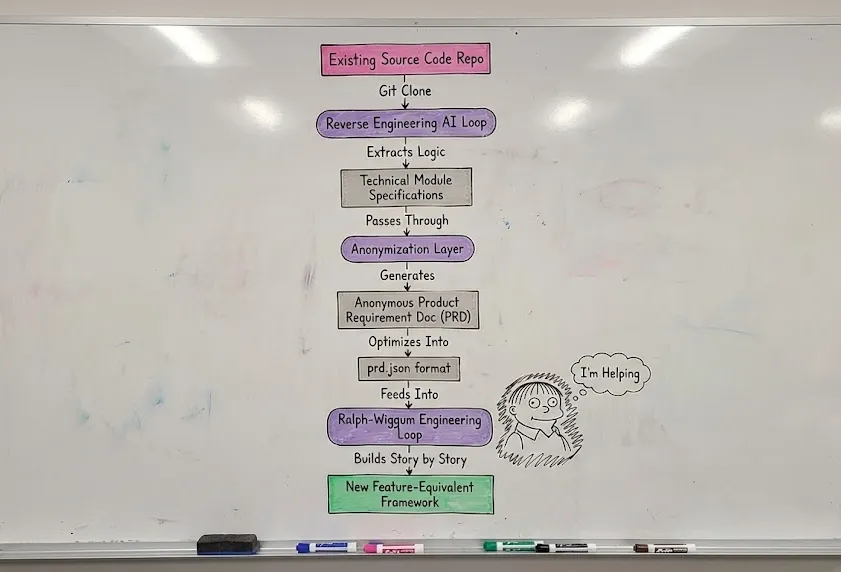
I cloned the repository, wrote a prompt that creates a technical specification out of each module and saves it for later use.
The next step was to make the technical specification product neutral. This is important and where I failed reviewing. This should prevent making your project identical. More on this later.
Now I have for each feature a product requirements document.
I fed all PRDs into an optimization pipeline that produces small units of feature specs. Here is the template I used.
{ "branchName": "ralph/feature-name", "taskDescription": "One-line summary of the task", "projectContext": { "framework": "e.g., Next.js, .NET", "testCommand": "e.g., npm test, dotnet test", "buildCommand": "e.g., npm run build, dotnet build" }, "userStories": [ { "id": "US-001", "title": "Short descriptive title", "description": "What to implement in detail", "acceptanceCriteria": [ "Specific, verifiable criterion 1", "Specific, verifiable criterion 2", "Build/test passes" ], "priority": 1, "passes": false, "notes": "Hints, gotchas, references to existing code" } ]}The prd.json, containing all features, are fed into the ralph loop. Now comes the fun part. You can do, whatever you want to do, until the loop finishes.
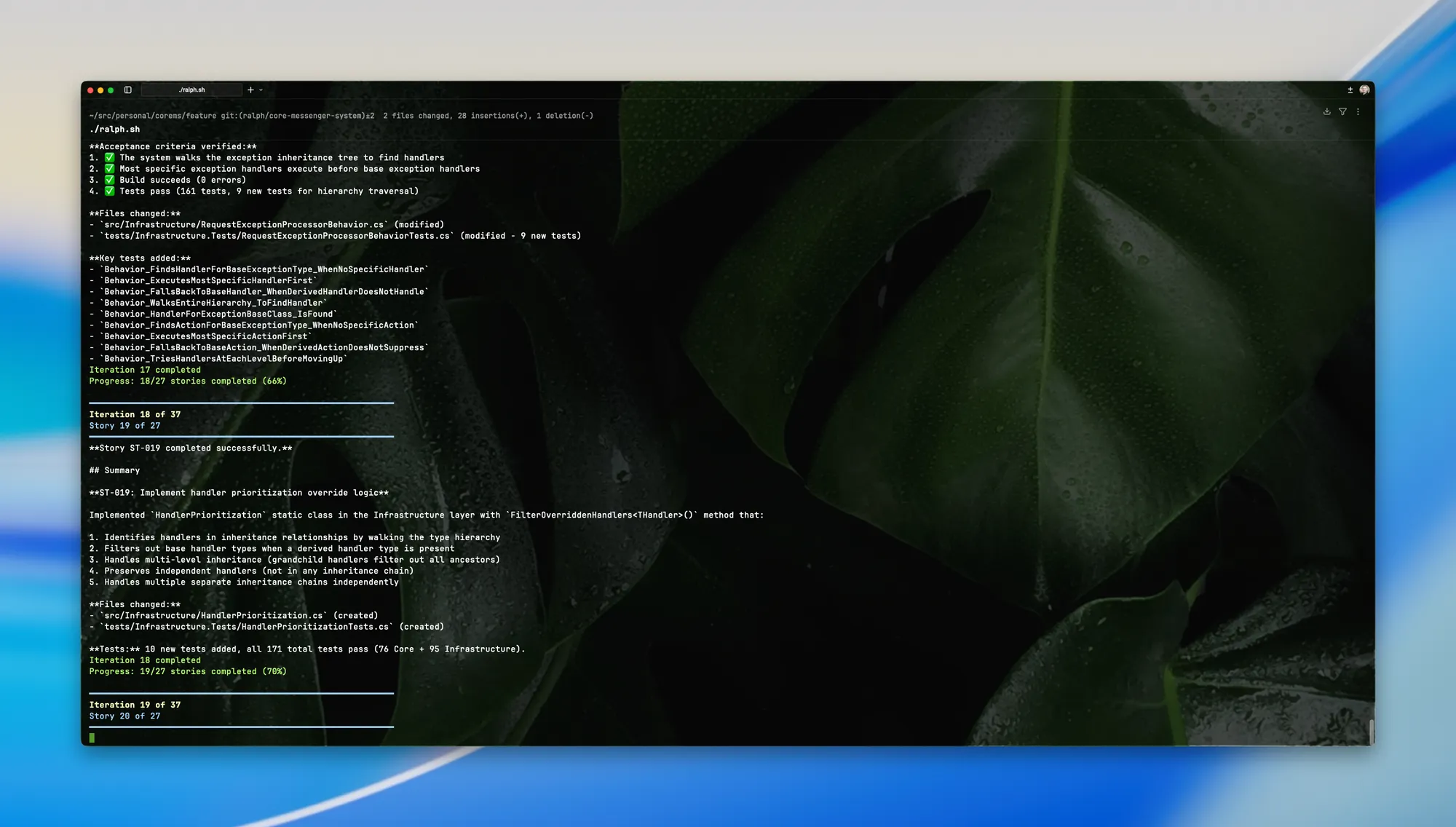
Ralph in action
The Result: Bote
Three hours later, I had a working .NET package - async pipelines, request/response handling, the core stuff. But looking at the generated code, I noticed a problem. It used the same runtime-reflection approach as MediatR. Functionally similar wasn’t architecturally distinct.
So I ran another pass, this time forcing a pivot to Source Generators. No more reflection. The result is cleaner separation, better performance, and native AOT support - things reflection-based libraries struggle with.
Also I wouldn’t lay my hand in fire for the performance part.
The Money Already Left
My experiment is just to prove to myself, yes this is working.
I heard a lot of people claiming that this is the silver bullet. In my opinion there is nothing like a silver bullet, but AI is for sure changing the value of code and the monetization game. And the latter is important for companies. Mindset has to switch fast or you are getting into real trouble.
For instance, the case of Tailwind Labs.
But the reality is that 75% of the people on our engineering team lost their jobs here yesterday because of the brutal impact AI has had on our business … Traffic to our docs is down about 40% from early 2023 despite Tailwind being more popular than ever. The docs are the only way people find out about our commercial products, and without customers we can’t afford to maintain the framework. … https://github.com/tailwindlabs/tailwindcss.com/pull/2388#issuecomment-3717222957
Usage is at an all-time high, but the money is gone.
Devs aren’t visiting documentation sites anymore - they ask their AI instead. So this business model doesn’t work anymore. The AI environment is the source of truth now, and it does the research when you need up-to-date docs. Not a human.
The same is true for software and services that can be reproduced with enough loops and patience. I believe you can also clone any closed-source product or service as long as there is public documentation available. You could create specifications out of those and feed it into AI to rebuild the same product.
What Are We Actually Selling?
If I can take a source-available project, run it through the Ralph Wiggum loop, and generate a functionally identical, good enough version in three hours… what is our unique value?
If an agent can see the inputs and the outputs, it can rebuild the middle. Your “unique” process isn’t unique if it can be reverse-engineered by a loop during your lunch break. The barrier to entry for complex software architecture has hit zero.
It sounds drastic but it is the new reality.
This Is The Beginning
Code is now disposable output of a specification. Libraries, frameworks, SaaS applications, apps, nothing is really unique nowadays, if you don’t have compelling business offers beyond the software.
We are in the beginning of a new movement. Creativity and ideas are more important than the execution of writing the stack. You could always let the stack build, but now it is super cheap and affordable for companies of all sizes. A solo developer with a loop can disrupt businesses that took teams years to build.
And honestly? I don’t know what the answer is. If you’re selling code, what are you actually selling now?